Solar Panel Installation Cost in India 2026
Thinking about installing solar panels at home but not sure how much it will actually cost?
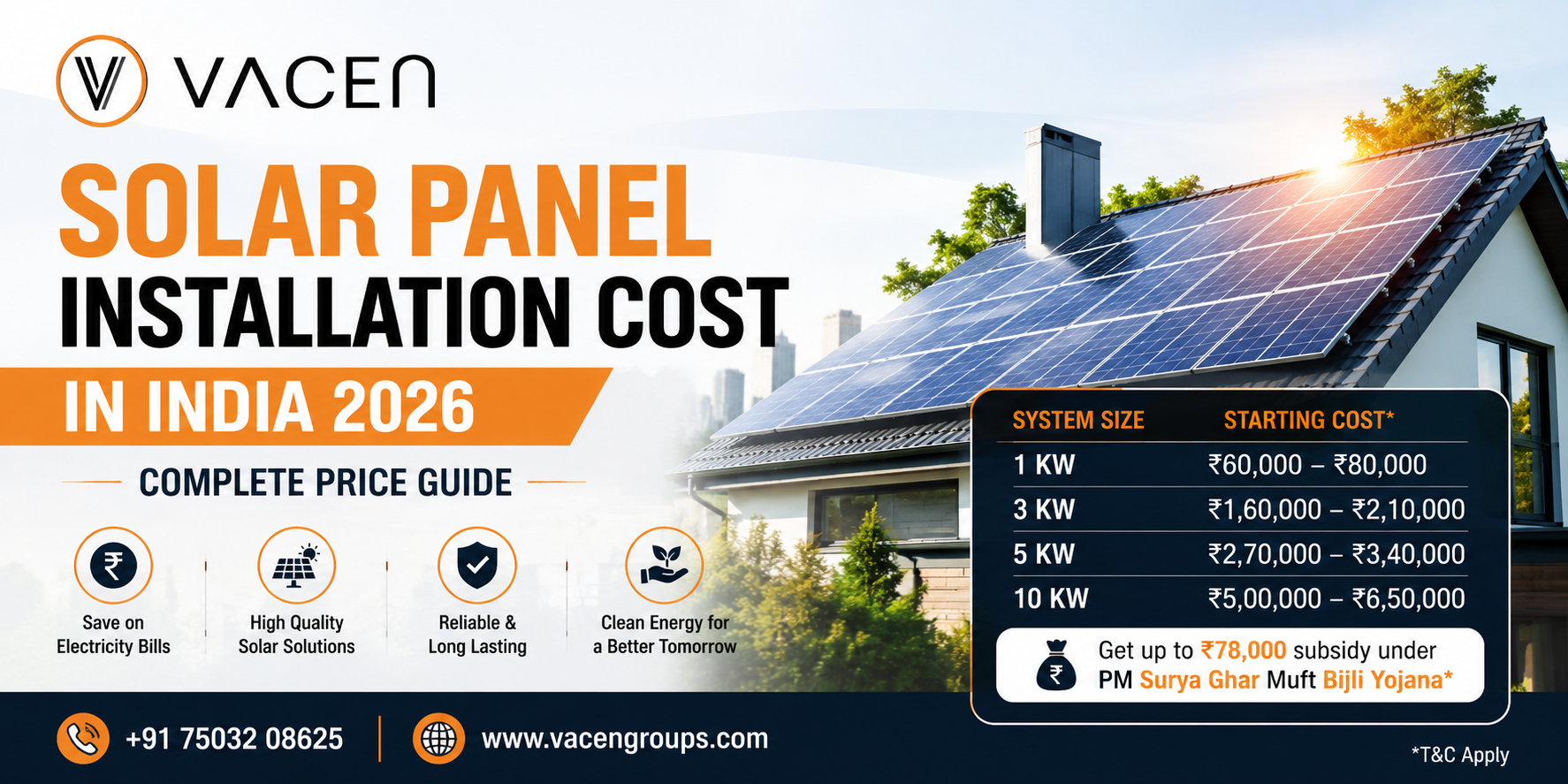
The solar panel installation cost in India depends on several things, including system size, panel technology, inverter, roof structure, installation requirements and your location. In 2026, a typical residential on-grid solar system can cost roughly ₹55,000–₹85,000 per kW before subsidy, although actual quotations can be lower or higher depending on the project. Current 2026 market guides show similar ranges across residential installations.
For eligible residential consumers, the PM Surya Ghar Muft Bijli Yojana can reduce the upfront cost through Central Financial Assistance of up to ₹78,000. The official scheme provides ₹30,000/kW for the first 2 kW and ₹18,000 for the additional 1 kW, with no additional central subsidy beyond 3 kW.
This guide explains the solar panel installation cost in India, including 1 kW, 3 kW and larger systems, what you actually pay after subsidy, factors affecting the price and how to choose the right system for your home.
Solar Panel Installation Cost in India in 2026
There is no single fixed price for a rooftop solar installation. Different installers may quote different prices for the same system because the equipment, roof and installation requirements can vary.
For a residential on-grid system, a practical 2026 market range is approximately:
|
Solar System |
Approx. Cost Before Subsidy |
Central Subsidy* |
Approx. Cost After Central Subsidy |
|
1 kW |
₹60,000–₹80,000 |
₹30,000 |
₹30,000–₹50,000 |
|
2 kW |
₹1.10–₹1.40 lakh |
₹60,000 |
₹50,000–₹80,000 |
|
3 kW |
₹1.60–₹2.10 lakh |
₹78,000 |
₹82,000–₹1.32 lakh |
|
5 kW |
₹2.70–₹3.40 lakh |
₹78,000 |
₹1.92–₹2.62 lakh |
|
10 kW |
₹5.00–₹6.50 lakh |
₹78,000 |
₹4.22–₹5.72 lakh |
*Central subsidy applies to eligible residential consumers under the applicable PM Surya Ghar rules.
These are indicative market ranges, not government-fixed prices. Recent 2026 market sources show broadly similar ranges, with the final price varying according to equipment, location, roof conditions and installation scope.
One important point
Don't compare solar quotations only by looking at the panel price. A complete installation can include:
- Solar panels
- Solar inverter
- Mounting structure
- DC and AC cables
- Protection devices
- Earthing
- Installation labour
- Commissioning
- Net-metering-related work
A very cheap quote may not include all of these items.
1 kW Solar Panel Price in India
If your electricity consumption is relatively low, a 1 kW solar system can be a starting point.
The current indicative 1 kW solar panel price in India for a complete residential rooftop system is around ₹60,000–₹80,000 before subsidy.
Under PM Surya Ghar, an eligible residential consumer can receive ₹30,000 central subsidy for 1 kW.
For example:
₹70,000 system cost − ₹30,000 subsidy = approximately ₹40,000 effective cost
However, your actual quotation will depend on the equipment and installation conditions.
A 1 kW system may be suitable for a home with relatively low electricity consumption. If your monthly consumption is much higher, a larger system may make more sense.
3 kW Solar Panel Cost: Why Is It So Popular?
For many Indian households, 3 kW is an attractive system size because it qualifies for the maximum central subsidy of ₹78,000 under PM Surya Ghar.
The current indicative 3kW solar panel cost is approximately ₹1.60–₹2.10 lakh before subsidy.
After the ₹78,000 central subsidy:
|
Example |
Amount |
|
Solar system cost |
₹1,60,000–₹2,10,000 |
|
PM Surya Ghar subsidy |
−₹78,000 |
|
Approx. balance |
₹82,000–₹1,32,000 |
For example, if an installer quotes ₹1.80 lakh for a complete 3 kW system:
₹1,80,000 − ₹78,000 = ₹1,02,000
This is why 3 kW is often considered a practical option for households with moderate-to-high electricity consumption.
The actual 3kW solar panel cost can change depending on the panel technology, inverter, structure, roof and installation requirements.
What Is Included in the Solar Panel Installation Cost?
When you receive a quotation, ask the installer what is included.
1. Solar Panels
Solar modules are one of the biggest components of the total system price. Different technologies such as mono PERC and newer N-type technologies can have different prices.
2. Solar Inverter
The inverter converts electricity generated by the panels into usable AC electricity for your home.
The inverter brand, efficiency, capacity, warranty and monitoring features can affect the total quotation.
3. Mounting Structure
Panels need a strong structure that can withstand wind and weather conditions.
A simple RCC rooftop installation may have different structural requirements from a sloping roof or metal-sheet roof.
4. Cables and Protection
A professional installation should include suitable DC/AC cables, protection equipment, isolators and surge protection.
5. Earthing
Proper earthing is important for electrical safety and should not be treated as an optional extra.
6. Installation and Commissioning
The quotation may include labour, installation, testing and commissioning.
7. Net Metering
For a grid-connected rooftop system, the installation process can also involve DISCOM approvals and net-metering-related work.
Always ask whether these costs are included in your quotation.
Household Solar Panel Cost: What Changes the Final Price?
The household solar panel cost is different for every home.
Here are the main factors that can increase or decrease your final price.
System Capacity
A 3 kW system will obviously cost more than a 1 kW system. However, larger systems can sometimes have a lower cost per kW because fixed installation costs are spread across more capacity.
Panel Technology
Higher-efficiency or newer panel technologies can have a higher upfront price but may provide advantages where roof space is limited.
Inverter Brand
A reliable inverter with good efficiency, warranty and after-sales support can cost more than an unknown brand.
Roof Structure
A straightforward RCC rooftop installation may be simpler than an installation requiring special mounting structures.
Roof Accessibility
If panels need to be carried several floors or the installation area is difficult to access, labour costs can increase.
Shadow and Orientation
Trees, neighbouring buildings and other structures can affect the system design. A professional site survey is important before finalising the system.
Location
Labour rates, transportation and local installation conditions can influence solar panel installation cost in India.
On-Grid vs Off-Grid vs Hybrid Solar Cost
The type of solar system you choose also affects the price.
On-Grid Solar
An on-grid system is connected to the electricity grid. It is generally the most economical option for homes that already have a reliable grid connection.
It can also work with net-metering or the applicable billing mechanism.
Off-Grid Solar
An off-grid system operates independently of the grid and generally requires batteries.
Because of the battery requirement, the initial cost can be considerably higher.
Hybrid Solar
A hybrid system combines grid connectivity with battery storage.
It can provide backup during power cuts but costs more than a basic on-grid system.
For a typical home mainly looking to reduce electricity bills, an on-grid system is often the first option worth evaluating.
How Much Roof Space Do You Need?
Roof space is another important factor.
A rough planning estimate for residential rooftop solar is:
|
System Size |
Approx. Roof Area |
|
1 kW |
80–100 sq. ft. |
|
2 kW |
160–200 sq. ft. |
|
3 kW |
250–300 sq. ft. |
|
5 kW |
400–500 sq. ft. |
|
10 kW |
800–1,000 sq. ft. |
Actual space requirements depend on the panel wattage, layout, mounting arrangement and required spacing.
Don't simply calculate the roof area and assume the entire space can be covered with panels. Maintenance access and shading should also be considered.
How Does PM Surya Ghar Subsidy Reduce Solar Cost?
The PM Surya Ghar scheme provides Central Financial Assistance to eligible residential consumers.
The central subsidy structure is:
- First 2 kW: ₹30,000 per kW
- Additional 1 kW: ₹18,000
- Maximum central subsidy: ₹78,000
For systems above 3 kW, the central subsidy remains capped at ₹78,000.
For example:
1 kW → ₹30,000 subsidy
2 kW → ₹60,000 subsidy
3 kW → ₹78,000 subsidy
5 kW → ₹78,000 subsidy
10 kW → ₹78,000 subsidy
The scheme also allows state governments to provide additional support, subject to their own programmes and the applicable PM Surya Ghar guidelines.
How to Choose the Right Solar System for Your Home
Don't choose a system simply because it has the highest subsidy.
Your electricity consumption should be the starting point.
A useful official PM Surya Ghar reference suggests:
|
Average Monthly Consumption |
Suggested Rooftop Solar Capacity |
|
0–150 units |
1–2 kW |
|
150–300 units |
2–3 kW |
|
Above 300 units |
Above 3 kW |
However, this should be treated as a starting point rather than a universal rule. Your actual system size should also consider roof area, daytime consumption, shading, local solar conditions and the applicable electricity billing arrangement.
Is Solar Worth the Installation Cost in 2026?
For many households, solar can make financial sense because it can reduce the amount of electricity purchased from the grid.
For example, imagine a household installs a 3 kW system for ₹1.80 lakh and receives ₹78,000 central subsidy.
The effective cost becomes approximately:
₹1,80,000 − ₹78,000 = ₹1,02,000
If the system generates around 12–15 units per day under suitable conditions, annual generation could be roughly 4,380–5,475 units. Actual generation varies significantly with location, weather, shading, system orientation and equipment.
If the household uses most of that generation effectively, the resulting electricity savings can help recover the investment over time.
A simple payback calculation is:
Payback period = Net solar investment ÷ Annual electricity savings
For example, if your effective investment is ₹1,02,000 and your annual electricity savings are ₹30,000:
₹1,02,000 ÷ ₹30,000 ≈ 3.4 years
This is only an illustration, not a guaranteed payback period. Electricity tariffs, solar generation, self-consumption and system performance can change the result.
How to Compare Solar Quotes
Before selecting an installer, ask for an itemised quotation.
Check:
Panel
- Brand
- Model
- Wattage
- Technology
- Warranty
Inverter
- Brand
- Capacity
- Efficiency
- Warranty
- Monitoring system
Installation
- Mounting structure
- Cables
- Earthing
- Protection devices
- Labour
- Commissioning
Approvals
- DISCOM application
- Net-metering process
- Subsidy assistance
Also ask whether GST and transportation are included.
Two installers may quote different amounts because their equipment and scope are different. Comparing only the final price can therefore be misleading.
Solar Panel Installation Cost in India: Final Takeaway
The solar panel installation cost in India in 2026 generally falls in the broad range of around ₹55,000–₹85,000 per kW before subsidy for residential on-grid systems, although actual quotations vary by project.
For many households, a 3 kW system is worth considering because eligible residential consumers can receive the maximum ₹78,000 central subsidy under PM Surya Ghar.
But don't select solar based on subsidy alone. The right system should match your electricity consumption, roof area and budget.
If you are comparing the household solar panel cost, 1 kW solar panel price in India, or 3kW solar panel cost, ask for a complete quotation rather than looking at panel prices alone.
A good solar installation is not simply the cheapest one. It should provide reliable equipment, proper installation, safe electrical protection, appropriate system sizing and dependable after-sales support.
Planning to install solar at your home? Get your roof and electricity consumption assessed before choosing the system size.