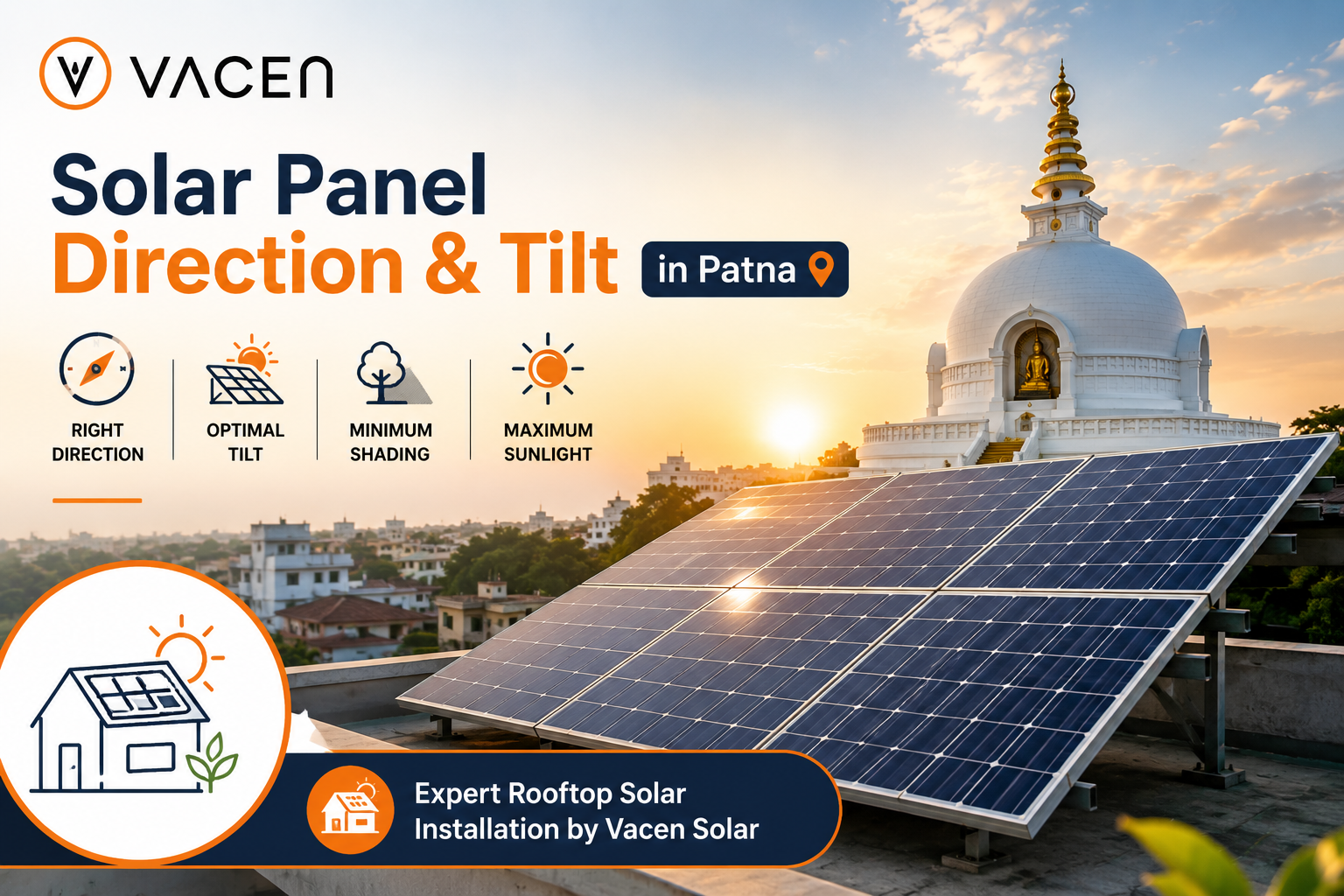
How Solar Panel Direction and Tilt Affect Solar Power Generation in Patna
Installing solar panels is an important investment, but simply putting panels on a rooftop does not guarantee maximum energy generation. Panel direction, tilt angle, available sunlight, shading, and roof structure all influence how much electricity a solar system can produce.
For homeowners and businesses considering rooftop solar in Patna, proper positioning is especially important. A professional solar energy company in Patna can assess the roof and design the system around the site's actual conditions instead of relying on a one-size-fits-all installation.
In this guide, we explain why solar panel direction and tilt matter, common positioning mistakes, and how professionals approach solar panel installation in Patna.
Why Solar Panel Direction Matters
Solar panels generate electricity when sunlight reaches their photovoltaic cells. The more useful sunlight the panels receive during the day, the better the potential energy output.
For fixed solar installations in India's northern hemisphere, south-facing orientation is generally the starting point for maximizing annual solar exposure. However, the exact direction should be selected after considering the roof shape, shading, electricity-use pattern, and available installation area.
For example, a roof may have a perfect south-facing section, but if a nearby building creates significant afternoon shade, another roof section could produce better real-world results.
This is why professional site assessment is important for rooftop solar Patna projects.
Does East or West Direction Work?
Yes. Solar panels do not stop producing electricity simply because they are not facing south.
- East-facing panels can receive stronger morning sunlight.
- West-facing panels can produce more energy later in the afternoon.
- South-facing panels are commonly preferred for maximizing annual production in the northern hemisphere.
- North-facing panels may receive less direct sunlight for a fixed installation and therefore require careful evaluation.
The best option depends on the property rather than direction alone.
Why Solar Panel Tilt Angle Matters
Direction determines where the panels face, while tilt determines how directly sunlight strikes the panel surface.
When sunlight hits a panel more directly, the available solar radiation on the panel can improve. An inappropriate tilt can therefore reduce annual generation.
An MNRE survey of photovoltaic installations in India found that non-optimized orientation and tilt can reduce annual PV generation, highlighting the importance of proper installation design.
A common starting principle for fixed solar systems is to consider the site's latitude when determining tilt. However, the final angle should not be decided from a simple rule alone.
Patna is located at approximately 25.6° North latitude.
Therefore, a professional installer may evaluate a tilt around this range as a starting point and then adjust it based on:
- Roof design
- Seasonal energy requirements
- Shading
- Panel row spacing
- Structural requirements
- Drainage and maintenance
- Wind conditions
- Available rooftop area
The ideal angle for your roof is not necessarily the same as the ideal angle on another property.
How Sunlight Availability Affects Solar Power Generation
Even correctly positioned panels cannot generate maximum electricity when sunlight is blocked.
The amount of usable sunlight changes throughout the day and across seasons. Trees, neighboring buildings, water tanks, parapet walls, antennas, and other rooftop structures can cast shadows on panels.
Even partial shading can affect the performance of a solar array, depending on the system design and electrical configuration.
For this reason, a professional solar assessment should examine the roof throughout the expected sun path rather than checking only whether the roof "looks sunny."
Common Sources of Rooftop Shading
Before installing solar panels, check for:
- Nearby buildings
- Tall trees
- Water tanks
- Chimneys
- Boundary walls
- Satellite dishes
- Electrical structures
- Future construction
Urban rooftops in Patna can have several of these obstacles, making proper site planning particularly important.
Common Solar Panel Positioning Mistakes
Choosing the wrong position can reduce the potential performance of a solar system. Some common mistakes include:
1. Installing Panels Without a Shade Analysis
A roof may appear sunny in the morning but become shaded in the afternoon. Installing panels without assessing the complete daily sun path can lead to unexpected generation losses.
2. Following Direction Without Considering the Roof
Simply saying "face everything south" is not always enough. A south-facing roof section with heavy shading may perform worse than a less perfectly oriented section with uninterrupted sunlight.
3. Using an Incorrect Tilt
Installing panels completely flat may simplify mounting, but it can affect sunlight exposure and maintenance. On the other hand, using an unnecessarily steep structure can increase spacing requirements and structural loads.
4. Ignoring Panel-to-Panel Shading
On flat roofs, panels are often installed in rows. If the rows are placed too close together, one row can cast shadows on another, particularly when the sun is lower in the sky.
5. Installing Panels Too Close to Obstacles
Water tanks, parapet walls, and other structures should be considered during the layout process. Leaving insufficient clearance can create shading and make future maintenance difficult.
How Professionals Determine the Right Solar Panel Placement
A reliable solar company in Patna should evaluate more than just the available roof area.
A professional site assessment generally considers:
1. Roof Orientation
The team checks the direction and usable sections of the roof.
2. Roof Tilt
Existing roof slopes are measured to determine whether panels can follow the roof or require a mounting structure.
3. Shading
Potential shading from buildings, trees, tanks, and other structures is evaluated.
4. Electricity Consumption
The customer's electricity usage helps determine the appropriate system size and expected generation requirements.
5. Panel Layout
Installers determine how many panels can fit while maintaining appropriate spacing, access, and maintenance areas.
6. Structural Requirements
The mounting structure must be suitable for the roof and local environmental conditions.
7. System Simulation
Professional designers may use solar design and simulation tools to compare orientation, tilt, shading, and expected energy generation before finalizing the layout.
This approach can help homeowners make a more informed investment rather than selecting a system based only on panel count.
Patna-Specific Considerations for Rooftop Solar
Patna's location at around 25.6°N latitude makes solar positioning an important part of rooftop system design.
For properties in Patna, installers should pay particular attention to:
Summer sunlight: Long, bright days can provide strong solar-generation opportunities, but high temperatures can also affect PV module operating efficiency.
Monsoon conditions: Cloud cover and rainfall can reduce available sunlight during some periods.
Dust and pollution: Dust accumulation can reduce the amount of sunlight reaching the panel surface, making regular cleaning and maintenance important.
Urban shading: Closely spaced buildings, trees, and rooftop structures can create localized shading.
Flat rooftops: Many homes and commercial buildings use flat concrete roofs, meaning mounting structures may be needed to achieve the desired orientation and tilt.
These factors make professional solar panel installation in Patna more valuable than simply installing panels wherever there is open roof space.
Why Professional Solar Installation Matters
A good solar system is not just about buying high-quality panels. Design, positioning, installation, electrical configuration, and maintenance all contribute to long-term performance.
The Ministry of New and Renewable Energy's rooftop solar programme provides a framework for grid-connected rooftop solar installations and includes processes involving vendors and DISCOM verification for applicable residential support.
Before installation, homeowners should therefore discuss:
- Expected electricity generation
- Panel orientation
- Tilt angle
- Shading assessment
- System capacity
- Mounting structure
- Maintenance requirements
- Grid connection and applicable procedures
A professional installer can explain these factors according to the property's specific requirements.
Choose the Right Solar Energy Company in Patna
If you're planning rooftop solar, the right installation design can make a significant difference to your system's long-term performance.
Vacen Solar provides solar solutions for residential, commercial, and industrial requirements, helping customers evaluate their site, select an appropriate system, and plan installation according to their energy needs.
If you're looking for a solar energy company in Patna, professional site assessment should be one of the first steps before purchasing a system.
Ready to explore rooftop solar for your property?
📞 Call Vacen Solar: +91 8368 927 313
🌐 www.vacensolar.com
📍 Patna, Bihar
FAQs
1. Which direction is best for solar panels in Patna?
For a fixed installation in Patna, south-facing orientation is generally a strong starting point for maximizing annual solar exposure. However, shading, roof design, and electricity-use patterns should also be considered before finalizing the direction.
2. What is the ideal solar panel tilt angle in Patna?
Patna is at approximately 25.6°N latitude, so latitude can provide a useful starting reference for fixed-panel tilt. The final angle should be determined based on the roof, shading, structural requirements, and system design.
3. Can solar panels be installed on a flat roof?
Yes. Flat roofs are commonly suitable for rooftop solar, but mounting structures may be required to achieve an appropriate orientation and tilt. Proper row spacing is also important to minimize panel-to-panel shading.
4. Does shading affect solar panel generation?
Yes. Shadows from trees, buildings, water tanks, parapet walls, and other structures can reduce solar generation. A professional shade assessment should be performed before installation.
5. Why should I choose a professional solar company in Patna?
A professional installer can assess your roof, electricity consumption, shading, orientation, tilt, structural requirements, and system size before installation. This helps create a solar system suited to your specific property rather than using a generic layout.