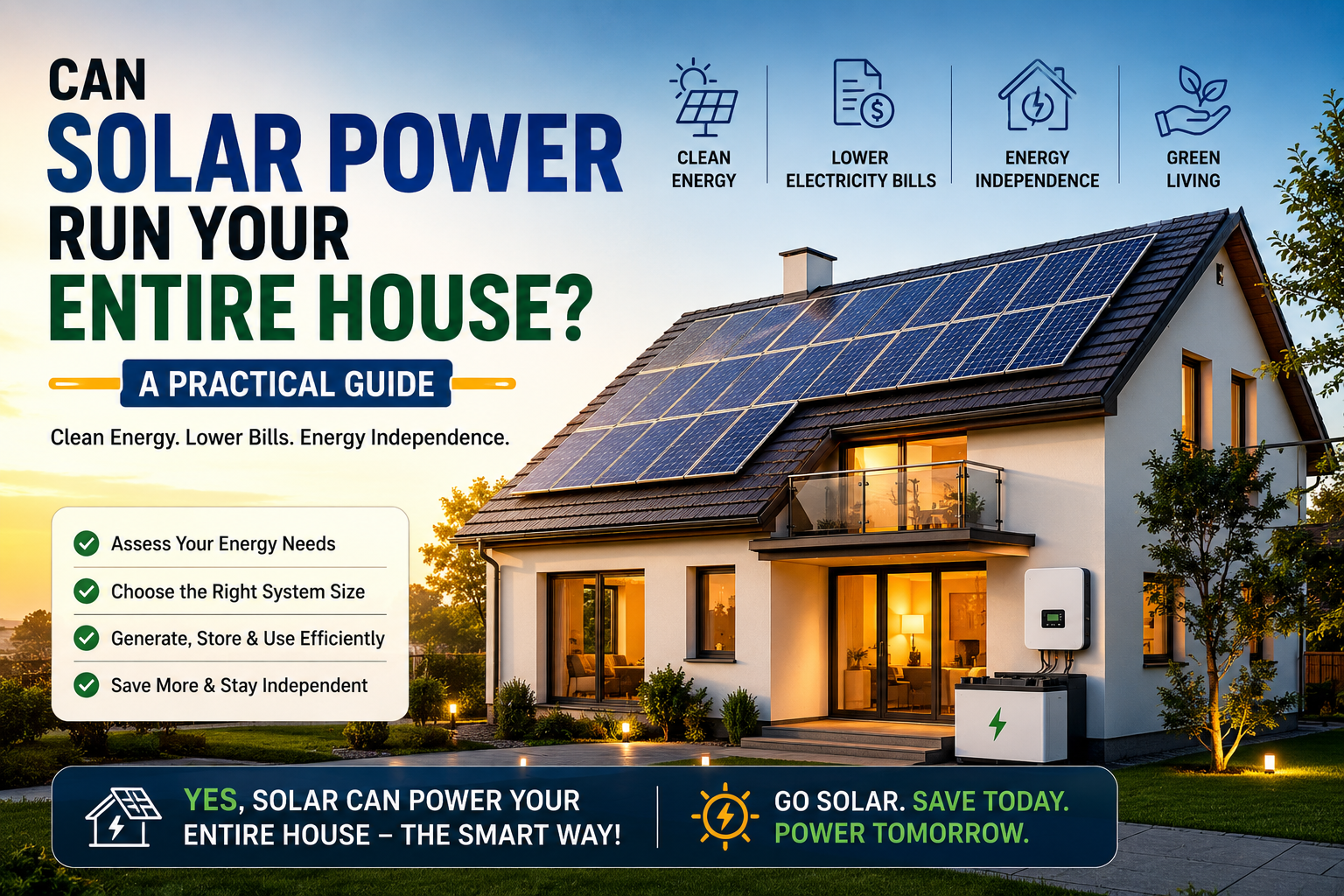
Can Solar Power Run Your Entire House? A Practical Guide
Every summer, the electricity bill goes up before the mercury does. Between air conditioners, water heaters, and a house full of appliances running through the day, most families end up asking the same question at some point: can solar power for your house actually take care of all of it, or is it just going to trim the bill a little?
The honest answer is — it depends on how you set it up. A correctly sized solar system for home use can absolutely cover 100% of what an average household consumes over a month. But "covering your usage" and "running your house independent of the grid, day and night" are two different things, and the difference comes down to a few design choices most people never get explained clearly. This guide walks through exactly what it takes.
What Does "Running Your Entire House on Solar" Actually Mean?
Before comparing costs or panel counts, it helps to separate two ideas that get mixed up constantly:
- Offsetting your electricity bill — your solar panels generate enough units over a month to match (or exceed) what your house consumes. The grid still supplies power at night; your panels send surplus back to the grid during the day.
- True independence — your house runs on stored solar power even when the sun isn't out, with little or no reliance on the grid.
Most homes going solar aim for the first outcome, because it's far more affordable. The second is possible, but it changes your system design completely. Here's how the three common setups compare:
Grid-Tied (On-Grid) Solar System
This is the most common and most affordable option for residential solar panels for your home. Panels feed power to your house during the day, and a bi-directional meter tracks whatever extra you send back to the grid through net metering. At night, you simply draw from the grid as usual. There's no battery, which keeps costs down — but during a power cut, the system shuts off too, for safety reasons.
Off-Grid Solar System
An off-grid setup has no grid connection at all. Every unit of power comes from your panels and a battery bank sized to cover your night-time and cloudy-day usage. This is the closest thing to "solar runs my entire house," but it's also the most expensive route, since batteries big enough for a full household load aren't cheap.
Hybrid Solar System
A hybrid system combines both — grid-tied for cost efficiency, with a battery for backup during outages or evening use. For most Indian households, this middle path offers the best balance between cost and self-sufficiency.
How Much Power Does Your House Actually Need?
Before anyone can size a solar system for home use, you need a realistic picture of your daily consumption. A rough breakdown for a typical urban household:
Daily Electricity Consumption
|
Appliance |
Typical Load |
Hours/Day |
Units (kWh)/Day |
|
Refrigerator |
150W |
24 |
3.6 |
|
4–5 Ceiling Fans |
75W each |
8 |
2.4 |
|
LED Lighting (8 points) |
10W each |
5 |
0.4 |
|
Television |
100W |
4 |
0.4 |
|
1.5-Ton AC |
1500W |
6 |
9.0 |
|
Water Pump |
750W |
1 |
0.75 |
|
Total (Approx.) |
— |
— |
~16.5 units/day |
At roughly 16–17 units a day, that household is consuming close to 500 units a month — on the higher side. A more moderate home without heavy AC use typically falls between 250–300 units a month, which is the range the government's flagship rooftop scheme is built around.
Bihar, UP, and most of North India get around 5 to 5.5 peak sun hours a day on average, which is the number installers use to convert your daily consumption into the system size (in kW) you'll actually need.
Solar Panels for Your Home: Sizing the System Correctly
As a rough guide, based on average sun hours in North India:
Solar System Size Based on Monthly Consumption
|
Monthly Consumption |
Recommended System Size |
Panels Needed (Approx. 540W Each) |
Roof Area Needed |
|
Up to 150 units |
1 kW |
2 panels |
~90–100 sq. ft |
|
150–300 units |
2–3 kW |
4–6 panels |
~180–270 sq. ft |
|
300–500 units |
5 kW |
9–10 panels |
~450 sq. ft |
|
500–1000 units |
10 kW |
18–20 panels |
~900 sq. ft |
These are starting estimates — actual sizing should always account for shading, roof orientation, and future consumption growth (an EV or a second AC unit, for instance). It's worth building in a 15–20% buffer rather than sizing to the exact number.
Solar Power for Home Cost in India (2026)
This is usually the deciding factor, so here's where things stand as of 2026.
Central government subsidy (PM Surya Ghar Muft Bijli Yojana):
- ₹30,000 per kW for the first 2 kW
- An additional ₹18,000 for the third kW
- Capped at ₹78,000 total, for systems of 3 kW and above
- Several states add their own top-up on this — some northern states offer extra support per kW, and select rural household schemes add further assistance, so it's worth checking your state's portal alongside the central one.
Approximate cost before and after subsidy:
Solar System Cost & Subsidy
|
System Size |
Approx. Cost (Before Subsidy) |
Approx. Central Subsidy |
Approx. Net Cost |
|
1 kW |
₹65,000–75,000 |
₹30,000 |
₹35,000–45,000 |
|
2 kW |
₹1.2–1.4 lakh |
₹60,000 |
₹60,000–80,000 |
|
3 kW |
₹1.9–2.0 lakh |
₹78,000 |
₹1.1–1.2 lakh |
|
5 kW |
₹3.0–3.4 lakh |
₹78,000 |
₹2.2–2.6 lakh |
|
10 kW |
₹5.8–6.5 lakh |
₹78,000* |
Varies by use case |
*Commercial systems and higher capacity slabs may have different subsidy eligibility.
These numbers are indicative market averages — actual solar power for home cost varies by city, roof condition, brand of panels and inverter, and whether you add a battery. Subsidy amounts and portal rules are also revised periodically by the Ministry of New and Renewable Energy, so it's worth confirming current figures before budgeting, either on the official portal or with your installer.
Add a battery to any of the above for backup, and expect it to add anywhere from ₹40,000 for a few hours of essential backup, to well over ₹2 lakh for a battery bank sized to run a full household overnight.
Can Solar Panels for Your House Really Cover 100% of Your Usage?
Here's the part most sales conversations skip. On paper, a well-sized grid-tied system can generate as many units over a month as your house consumes — meaning your net bill can drop to near zero. But that's a monthly, on-paper balance, not real-time coverage.
In practice:
- During the day, your panels power your house directly and send any surplus to the grid.
- At night, since there's no sun, a grid-tied system pulls from the grid as normal — net metering settles the difference at billing time, not the moment power is used.
- During a grid outage, a plain grid-tied system switches off automatically for safety, even if the sun is shining.
So if the goal is genuinely running your entire house — including at night and during outages — a hybrid or off-grid system with adequately sized battery storage is the only way to get there. It costs more, but it's the honest answer to the question in this guide's title.
Step-by-Step: Getting a Solar System for Your Home
1. Check your last 6–12 months of electricity bills to get an accurate average consumption figure — this is more reliable than guessing from appliances alone.
2. Get a roof assessment for available space, shading from trees or neighbouring buildings, structural strength, and orientation.
3. Decide on system type — grid-tied for cost savings, hybrid if backup during outages matters to you.
4. Choose ALMM-compliant panels from an MNRE-empanelled installer — this isn't optional if you want the subsidy to go through.
5. Register on the PM Surya Ghar portal, upload your electricity bill and ID proof, and complete the DISCOM approval step (largely streamlined and faster in the current version of the scheme).
6. Installation and net metering setup — typically completed within a few days for a residential-scale system.
7. Inspection and commissioning by the DISCOM, after which the subsidy is credited directly to your bank account, usually within 30–45 days.
Common Mistakes Homeowners Make
- Undersizing the system to save upfront cost, then finding it doesn't cover peak summer AC load.
- Ignoring shading from a tree or water tank that quietly cuts output by 20–30%.
- Skipping ALMM compliance to save a little on panel cost, and losing subsidy eligibility entirely.
- Assuming net metering means real-time backup — as covered above, it doesn't, without a battery.
- Going with an uncertified installer for a lower quote, and dealing with poor wiring, undersized inverters, or warranty issues later.
Is It Worth It?
For a typical 3 kW grid-tied system, the combination of subsidy and monthly savings usually brings the payback period down to about 2–3 years, with an estimated ₹7–10 lakh in savings over a 25-year panel lifespan — though this varies with your consumption, local tariffs, and sunlight hours, so treat it as a ballpark rather than a guarantee for your specific home.
Frequently Asked Questions
1. Can solar power run my entire house without any electricity bill?
A correctly sized grid-tied system can bring your net bill close to zero over a month through net metering. For true round-the-clock independence, including at night, you'll need a hybrid or off-grid system with battery storage.
2. How many solar panels do I need for a 3 kW system?
With commonly used 540W panels, a 3 kW system needs roughly 5–6 panels, depending on the exact panel wattage and system design.
3. Do I need a battery to run my house fully on solar?
Yes — without a battery, a grid-tied system only supplies power while the sun is up, and switches off during outages. A battery is what makes night-time and outage coverage possible.
4. What is the government subsidy for solar panels in India right now?
Under the PM Surya Ghar Muft Bijli Yojana, the central subsidy is ₹30,000 per kW for the first 2 kW, plus ₹18,000 for the third kW, capped at ₹78,000 for systems of 3 kW and above. Several states add further support on top of this.
5. How long does it take to install solar panels for a home?
Physical installation for a residential system typically takes a few days; the full process including portal registration, DISCOM approval, net metering, and subsidy disbursal usually spans 4–8 weeks.
Final Thoughts
Solar power for your house isn't an all-or-nothing decision. A well-sized grid-tied system can realistically wipe out most or all of your monthly bill, and a hybrid setup can get you close to true independence if backup during outages matters to you. The right starting point is an honest look at your actual consumption, your roof, and how much backup you genuinely need — not just the system size a quote sheet suggests.
At Vacen Group, our certified engineers have spent close to two decades designing and installing residential, commercial, and industrial solar systems across Bihar, UP, Delhi, and Haryana. If you'd like an honest, load-based recommendation for your own home, [get in touch with our team](https://vacengroups.com/contact-us) for a free consultation and quote.