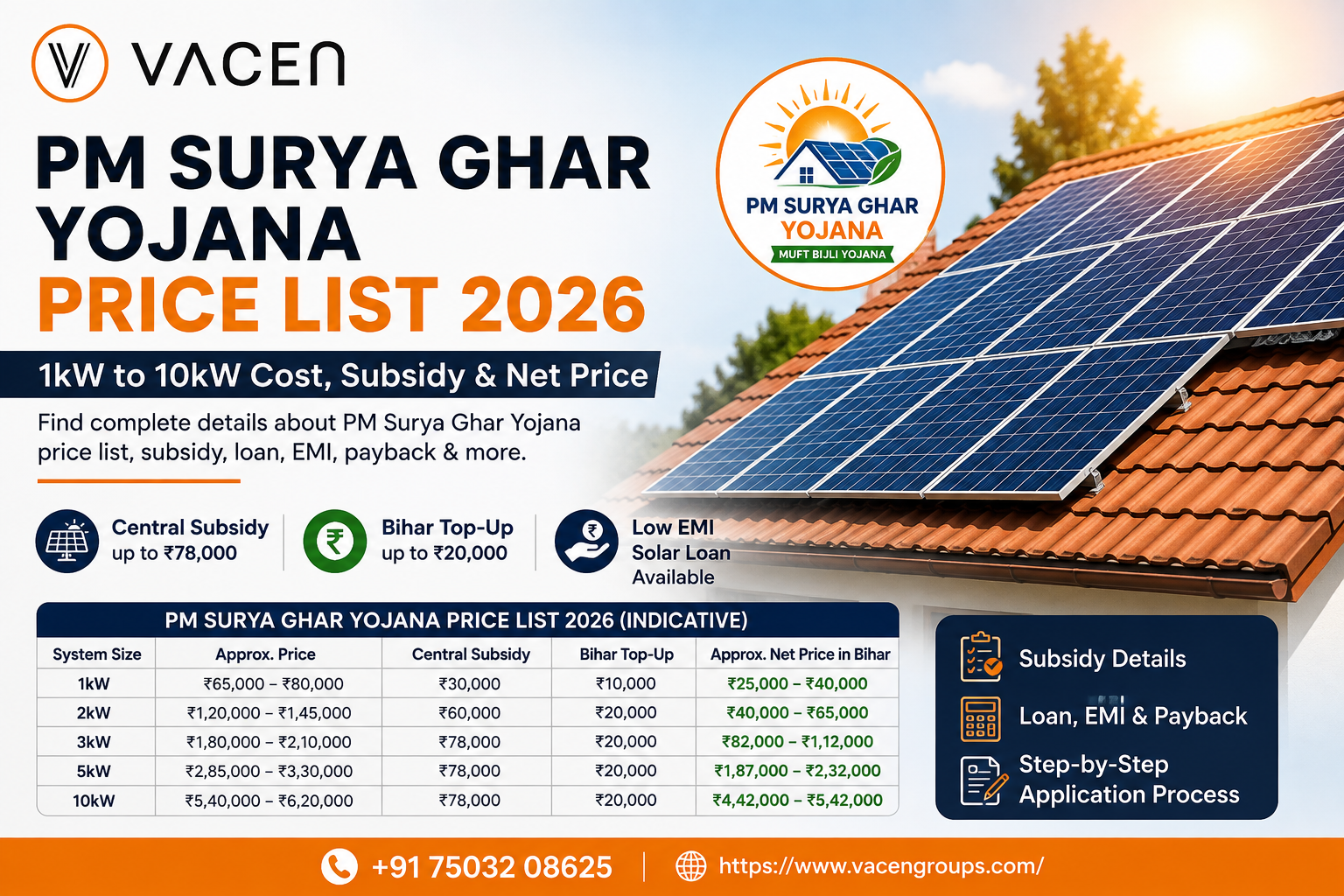
PM Surya Ghar Yojana Price List
If you are planning to install rooftop solar in 2026, one of the first questions is: What is the PM Surya Ghar Yojana price list and how much will I actually have to pay after subsidy?
The answer depends on your solar system size, panel and inverter brand, roof structure, installation requirements, and location. The central government subsidy is straightforward: residential consumers can receive ₹30,000/kW for the first 2 kW and ₹18,000 for the third kW, with the central subsidy capped at ₹78,000. Systems larger than 3 kW do not receive additional central subsidy.
For Bihar residents, there is an important 2026 update: the Bihar government has approved an additional ₹10,000/kW, capped at ₹20,000 per residential consumer, on top of the central assistance. Current reporting says the state support is subject to eligibility, a five-lakh-consumer ceiling and first-come, first-served implementation.
This guide explains the PM Surya Ghar Yojana price list 2026, subsidy, Bihar top-up, 3kW cost, loans, EMI, payback and application process.
PM Surya Ghar Yojana Price List 2026: 1kW to 10kW
There is no single government selling price for a rooftop solar system. The government determines the subsidy, while the actual installation price depends on the vendor, components, roof, design and installation scope.
The following is an indicative 2026 market-price range for a residential on-grid system, including typical panels, inverter, mounting structure, wiring and installation, but excluding optional battery backup. Current 2026 market references put typical residential systems broadly around ₹55,000–₹70,000+ per kW, with actual quotes varying by system size and components.
|
System Size |
Approx. Price Before Subsidy |
Central Subsidy |
Bihar State Top-Up* |
Approx. Net Price in Bihar |
|
1 kW |
₹65,000–₹80,000 |
₹30,000 |
₹10,000 |
₹25,000–₹40,000 |
|
2 kW |
₹1.20–₹1.45 lakh |
₹60,000 |
₹20,000 |
₹40,000–₹65,000 |
|
3 kW |
₹1.80–₹2.10 lakh |
₹78,000 |
₹20,000 |
₹82,000–₹1.12 lakh |
|
4 kW |
₹2.40–₹2.75 lakh |
₹78,000 |
₹20,000 |
₹1.42–₹1.77 lakh |
|
5 kW |
₹2.85–₹3.30 lakh |
₹78,000 |
₹20,000 |
₹1.87–₹2.32 lakh |
|
6 kW |
₹3.40–₹3.90 lakh |
₹78,000 |
₹20,000 |
₹2.42–₹2.92 lakh |
|
7 kW |
₹3.90–₹4.50 lakh |
₹78,000 |
₹20,000 |
₹3.02–₹3.52 lakh |
|
8 kW |
₹4.40–₹5.10 lakh |
₹78,000 |
₹20,000 |
₹3.62–₹4.32 lakh |
|
9 kW |
₹4.90–₹5.65 lakh |
₹78,000 |
₹20,000 |
₹4.12–₹4.67 lakh |
|
10 kW |
₹5.40–₹6.20 lakh |
₹78,000 |
₹20,000 |
₹4.42–₹5.42 lakh |
*Bihar's additional assistance is subject to the applicable state eligibility and programme limits. The ₹10,000/kW state support is capped at ₹20,000 per consumer.
Important: The 7kW and 9kW figures above are planning estimates based on current 2026 market pricing between the published system-size benchmarks; they are not government-fixed prices. A final quote should be based on your site survey and selected equipment. Current market references show, for example, approximately ₹1.80–₹2.10 lakh for 3kW and ₹2.85–₹3.30 lakh for 5kW systems.
What Is PM Surya Ghar Yojana?
PM Surya Ghar: Muft Bijli Yojana is a central government programme designed to encourage residential rooftop solar installation. The scheme aims to support rooftop solar for one crore households and was approved with an overall outlay of ₹75,021 crore. Residential consumers with a grid-connected electricity connection can apply through the national portal.
The idea is simple: install a grid-connected rooftop solar system, generate electricity at home, use the solar power during the day and export surplus electricity to the grid according to the applicable net-metering/billing arrangement.
The scheme can therefore reduce electricity purchases from the grid, although your final bill will still depend on consumption, solar generation, fixed charges and the applicable DISCOM rules.
PM Surya Ghar Yojana Subsidy: How Much Do You Get?
The central subsidy structure for residential consumers is:
- 1kW: ₹30,000
- 2kW: ₹60,000
- 3kW: ₹78,000
- Above 3kW: Central subsidy remains capped at ₹78,000
The ₹78,000 maximum comes from ₹30,000/kW for the first 2kW plus ₹18,000 for the third kW.
Learn more
The subsidy is for eligible residential rooftop solar installations. It should not be confused with the total cost of the solar plant or with commercial solar incentives.
The actual amount credited and the process depend on successful installation, verification and the applicable portal/DISCOM process. MNRE states that CFA can be transferred to the consumer's account after successful installation and verification by the DISCOM.
Bihar Solar Subsidy 2026: Central Subsidy + State Top-Up
Bihar has introduced an important additional incentive in 2026.
The state has approved ₹10,000 per kW, with a maximum state contribution of ₹20,000 per residential consumer, in addition to PM Surya Ghar's central assistance. Current reports state that the programme is intended for eligible residential consumers and is subject to a five-lakh-consumer ceiling and first-come, first-served implementation.
This gives the following maximum combined support:
|
System |
Central Subsidy |
Bihar Top-Up |
Combined Support |
|
1kW |
₹30,000 |
₹10,000 |
₹40,000 |
|
2kW |
₹60,000 |
₹20,000 |
₹80,000 |
|
3kW |
₹78,000 |
₹20,000 |
₹98,000 |
|
5kW |
₹78,000 |
₹20,000 |
₹98,000 |
|
10kW |
₹78,000 |
₹20,000 |
₹98,000 |
So, for a qualifying 3kW residential installation in Bihar, the combined assistance can reach ₹98,000.
Example
Suppose a 3kW system costs ₹1.90 lakh.
- System cost: ₹1,90,000
- Central subsidy: ₹78,000
- Bihar assistance: ₹20,000
- Approximate balance: ₹92,000
The actual amount will depend on the final vendor quote and whether all applicable state and central assistance is available to that consumer.
3kW Solar System Price in India With Subsidy
The 3kW solar system price in India with subsidy is one of the most searched questions because 3kW is a common size for Indian homes and it is also the point at which the maximum central PM Surya Ghar subsidy is reached.
Current 2026 market references put a typical 3kW on-grid system around ₹1.80–₹2.10 lakh before central subsidy, although lower or higher quotes are possible depending on components and installation conditions.
Example 3kW Calculation
|
Particular |
Amount |
|
Approx. system price |
₹1,80,000–₹2,10,000 |
|
Central PM Surya Ghar subsidy |
−₹78,000 |
|
Bihar state assistance |
−₹20,000 |
|
Approx. effective cost |
₹82,000–₹1,12,000 |
This is why the PM Surya Ghar Yojana 3kW price can look significantly lower after eligible assistance.
However, don't compare quotes only on price. Check the panel technology, inverter brand, module warranty, installation quality, mounting structure, protection devices, earthing, net-metering support and after-sales service.
What Factors Affect Solar System Price?
Two 3kW solar quotes can have noticeably different prices. Common reasons include:
1. Solar Panel Brand and Technology
N-type TOPCon, mono PERC and other module technologies have different pricing and performance characteristics.
2. Inverter
The inverter is a major part of an on-grid system. Brand, efficiency, warranty and monitoring features can affect the total price.
3. Mounting Structure
The structure needs to suit your roof. RCC, metal-sheet and other roof types may require different mounting arrangements.
4. Roof Condition
A difficult roof, extra height, shading or structural work can increase installation costs.
5. Electrical Protection
Proper DC/AC protection, earthing, cables, isolators and surge protection should be included in a professional installation.
6. Net-Metering Work
DISCOM-related documentation, inspection and meter-related work can affect the installation scope.
7. Battery Backup
A normal on-grid PM Surya Ghar system does not automatically include a battery. Adding batteries or converting to a hybrid system increases the cost substantially.
3kW Solar System Payback Calculation
A simple payback estimate can help you understand whether solar makes financial sense.
A 3kW rooftop system can typically generate around 12–15 units per day, depending on location, season, orientation, shading and system efficiency.
For example, assume:
- Average generation: 13.5 units/day
- Annual generation: ~4,928 units
- Effective electricity value: ₹6.50/unit
Estimated annual energy value:
4,928 × ₹6.50 ≈ ₹32,000/year
If the effective installation cost in Bihar is approximately ₹82,000–₹1.12 lakh after the combined assistance, a simple payback could be roughly 2.5–3.5 years under favourable conditions.
This is only an illustration. Actual payback can be longer because electricity tariffs, fixed charges, self-consumption, export settlement, system generation and maintenance all affect savings.
Solar Loan and EMI Under PM Surya Ghar
If paying the entire balance upfront is difficult, eligible consumers can also explore solar loans.
For example, Bank of India currently lists a PM Surya Ghar rooftop solar loan starting at 5.75% p.a., with individual loan limits up to ₹6 lakh and repayment tenure up to 120 months.
Central Bank of India also lists financing up to ₹6 lakh, with a maximum 120-month tenure, and states that loans up to ₹2 lakh can be available under its scheme without a minimum income requirement; conditions differ for larger loans.
Indian Bank's current scheme provides up to ₹2 lakh for systems up to 3kW and up to ₹6 lakh for systems above 3kW to 10kW, with applications routed through Jan Samarth.
Example EMI
Suppose your effective 3kW project cost after applicable assistance is ₹1,00,000 and you finance the full amount at approximately 5.75% for five years.
The EMI would be roughly ₹1,920 per month.
Your actual EMI will depend on:
- Loan amount
- Interest rate
- Tenure
- Bank
- Credit profile
- Processing charges
- Borrower contribution
Interest rates are floating and can change. SBI and other banks publish their own current rates and eligibility conditions, so always check the lender's latest terms before taking a loan.
How to Apply for PM Surya Ghar Yojana
The basic application process is:
Step 1: Register on the National Portal
Register your residential electricity connection on the official PM Surya Ghar portal.
Step 2: Enter Your Consumer Details
Provide the required electricity connection and applicant information.
Step 3: Choose a Vendor
The national portal allows eligible consumers to choose a vendor and solar equipment according to the scheme process.
Step 4: Site Assessment
The selected vendor assesses your roof, electricity requirement, shadow-free area, system size and installation requirements.
Step 5: Finalise the System
Confirm the quotation, equipment specifications, installation scope and warranty terms.
Step 6: Installation
The vendor installs the rooftop solar system according to the applicable technical requirements.
Step 7: Inspection and Net Metering
The DISCOM verifies the installation and completes the applicable net-metering process.
Step 8: Subsidy Processing
After successful installation and verification, the eligible central subsidy is processed according to the scheme guidelines.
For loans, banks such as Indian Bank state that applicants first register on the PM Surya Ghar portal and then apply through Jan Samarth.
PM Surya Ghar Yojana in Bihar and Patna
Bihar is seeing strong rooftop-solar activity under the scheme. In August 2026, Patna district authorities reported that more than 11,600 households had already been covered under PM Surya Ghar, including more than 10,300 non-BPL homes. The district has also set further installation targets.
For consumers in Patna, the relevant DISCOM depends on the location. Bihar's DISCOMs are actively publishing PM Surya Ghar vendor and rooftop-solar information, while BREDA provides state renewable-energy information and useful links for net-metering and related programmes.
Before ordering a system, check:
- Your monthly electricity consumption
- Available shadow-free roof area
- Your DISCOM
- Current subsidy eligibility
- Bihar state top-up availability
- Vendor empanelment/status
- Panel and inverter specifications
- Warranty
- Net-metering support
- Total installed cost
Who Should Choose 1kW, 2kW, 3kW or 5kW?
A rough guide:
1kW: Suitable for low electricity consumption and smaller homes.
2kW: Suitable for households with moderate consumption.
3kW: A popular choice for many homes because it reaches the maximum central subsidy level.
5kW: Better suited to larger homes with higher consumption, multiple appliances or AC usage.
10kW: Usually makes sense for very high residential consumption or larger properties. The central subsidy does not increase beyond ₹78,000.
Your actual system size should be selected using your electricity consumption and roof conditions rather than simply choosing the largest system eligible for subsidy.
FAQs About PM Surya Ghar Yojana Price List
1. What is the PM Surya Ghar Yojana price list for 2026?
There is no fixed government selling price. A typical residential rooftop system can range from roughly ₹65,000 for 1kW to around ₹5.4–₹6.2 lakh for 10kW, depending on equipment and installation.
2. What is the PM Surya Ghar Yojana subsidy for 3kW?
The central subsidy for a qualifying 3kW residential system is ₹78,000.
3. What is the Bihar subsidy for PM Surya Ghar?
Bihar has approved additional assistance of ₹10,000/kW up to a maximum of ₹20,000 per consumer, subject to the applicable state programme conditions.
4. What is the PM Surya Ghar Yojana 3kW price in Bihar?
A typical 3kW system may cost around ₹1.80–₹2.10 lakh before assistance. With ₹78,000 central support and up to ₹20,000 Bihar assistance, the indicative effective cost can be approximately ₹82,000–₹1.12 lakh.
5. Is subsidy available above 3kW?
Yes, eligible residential systems above 3kW can still receive the central subsidy, but the central amount is capped at ₹78,000.
6. Can I get a loan for a solar system?
Yes. Several banks offer PM Surya Ghar-linked rooftop solar loans. Loan amount, interest rate and tenure vary by bank and borrower.
7. Does PM Surya Ghar include a battery?
Not automatically. Standard grid-connected rooftop systems generally work with the electricity grid and net metering. Battery backup is an additional requirement and increases project cost.
8. Is PM Surya Ghar only for homeowners?
Eligibility depends on the scheme requirements, but residential consumers need an eligible electricity connection and suitable premises/roof. The official process should be checked before installation.
9. How long does a solar system last?
Solar panels are generally designed for long-term operation, with manufacturers offering performance warranties that commonly extend for decades. Actual lifespan depends on equipment quality, installation and maintenance.
10. What does PM Surya Ghar Muft Bijli Yojana mean?
In simple terms, PM Surya Ghar Muft Bijli Yojana is a government programme supporting residential rooftop solar, with the objective of helping households generate their own electricity and reduce their dependence on grid electricity.
Final Verdict: Is Solar Worth It in 2026?
The PM Surya Ghar Yojana price list 2026 makes rooftop solar particularly attractive for households that have sufficient roof space and regular electricity consumption.
For many Bihar households, the combination of the central subsidy up to ₹78,000 and the newly approved Bihar assistance up to ₹20,000 can significantly reduce the initial cost.
A 3kW system is especially worth considering because it reaches the maximum central subsidy while remaining suitable for many typical households. But the cheapest quote is not necessarily the best quote. Panel quality, inverter reliability, installation standards, warranty, protection equipment and after-sales service can make a major difference over the life of the system.
If you are in Patna or elsewhere in Bihar, Vacen Solar can help you understand your electricity consumption, evaluate your roof, select an appropriate system size and understand the applicable subsidy and installation process.
Want to know how much a solar system will cost for your home?
📞 Call Vacen Solar: +91 75032 08625
Visit Vacen Solar